Can I cut stainless steel with oxygen instead of nitrogen?
Updated:
Short answer
Yes, and it is faster and cheaper than nitrogen, but the edge oxidises: it turns dark or straw-coloured and loses corrosion resistance right at the cut. It suits thick plate, structural parts and anything that gets ground or painted afterward — not visible or weld-critical parts.
When oxygen on stainless makes sense
| Symptom | Likely cause | First action |
|---|---|---|
| Thick stainless plate where nitrogen speed drops too low. | Nitrogen cutting slows dramatically past 12–15 mm; oxygen keeps cutting at a practical rate. | Switch to oxygen for plate where nitrogen cycle time is no longer viable. |
| Part gets welded afterward. | An oxidised edge needs grinding back to bare metal before a clean weld anyway. | Oxygen is fine — the grinding step happens regardless of which gas cut the edge. |
| Part is decorative or stays visible. | A discoloured, oxidised edge is a cosmetic defect on show surfaces. | Use nitrogen instead; the edge cost is worth it for appearance. |
| Part will see food contact or a corrosive environment. | Oxidation at the cut compromises the corrosion resistance stainless is chosen for. | Use nitrogen, or plan for post-cut passivation of the oxygen-cut edge. |
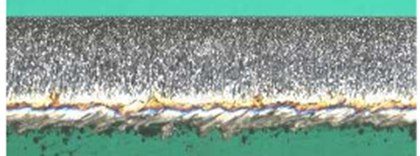
Compare nitrogen and oxygen parameters for stainless side by side — inside the app. Open SBM Laser Help →
Or take it with you:
Stainless with oxygen vs nitrogen — what changes
| Oxygen | Nitrogen | |
|---|---|---|
| Edge | Dark, oxidised, straw to blue | Bright, clean, weldable as-is |
| Speed, 10 mm | Faster | Slower |
| Gas pressure | Low, 1–3 bar | High, 16–20 bar |
| Gas cost | Lower | Higher |
| Best for | Thick plate, structural, ground/painted parts | Visible parts, weld-ready edges, food/corrosive use |
Speed and pressure are directional; see the parameter tables inside the app for your thickness.
Related questions
- Does oxygen-cut stainless rust?
- Not the bulk material, but the oxidised layer right at the cut has reduced chromium-oxide protection until it is cleaned or passivated — a real consideration in wet or salty environments.
- Can I switch gases mid-job on the same part?
- Some shops pierce with oxygen and cut with nitrogen on thick plate to save pierce time while keeping a clean cut edge — the controller just needs a gas-change step in the program.
- Is oxygen-cut stainless weaker?
- No — cutting gas does not change bulk mechanical properties, only the surface condition right at the kerf.