How do I get rid of dross when cutting mild steel with oxygen?
Updated:
Short answer
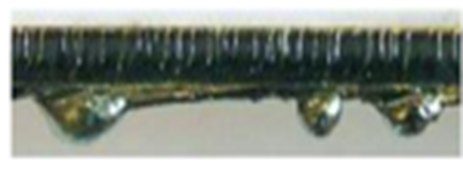
Dross on mild steel is molten oxide that solidified before the gas could remove it. The usual levers, in this order: oxygen pressure (often too high on thick plate), cutting speed, focus position, and nozzle standoff. On plate above 10 mm, most dross problems are a pressure and focus problem, not a power problem.
Where dross comes from
| Symptom | Likely cause | First action |
|---|---|---|
| Coarse, irregular dross on plate over 8 mm; edge looks eroded. | Oxygen pressure too high for the thickness | Drop pressure: thick plate wants low pressure — often 0.5–0.8 bar at 15–20 mm, not 2 bar. |
| Dross plus striation lines that lag backwards at the bottom of the kerf. | Speed slightly too high | Reduce feed 5–10%. Oxygen cutting relies on the exothermic reaction keeping pace with the head. |
| Dross uniform along the contour and hard to knock off. | Focus in the wrong plane | For oxygen, focus sits at or slightly above the surface; verify after any optics work. |
| Gas jet spreads, dross appears together with wider kerf. | Standoff too large | Set 0.7–1.0 mm for typical plate; confirm the capacitive sensor is calibrated on the real material. |
| Dross only on some sheets from the same order. | Mill scale or rust on the surface | Cut scale-side down where possible, or move to a parameter set for hot-rolled material. |
Oxygen pressure and speed for mild steel by thickness — inside the app. Open SBM Laser Help →
Or take it with you:
Dialling dross out
- Cut a 100 mm test line at current parameters and keep it as the reference sample.
- Lower oxygen pressure in 0.1 bar steps, cutting a line at each step, until dross changes character.
- Adjust speed ±10% around the best pressure and pick the cleanest underside.
- Verify focus and standoff, then repeat the two-step sweep once — the optimum moves after focus changes.
- Record the winning combination in your own table; oxygen parameters are far more material-batch sensitive than nitrogen.
Oxygen cutting on mild steel — typical starting ranges (6 kW fiber)
| Thickness | Nozzle | Oxygen pressure | Focus vs surface | Speed |
|---|---|---|---|---|
| 3 mm | 1.0–1.2 mm single | 3.5–5 bar | 0 mm | 4.5–6 m/min |
| 6 mm | 1.2–1.5 mm single | 1.5–2.5 bar | +1 mm | 3–4 m/min |
| 10 mm | 1.5 mm single | 0.8–1.2 bar | +2 mm | 2.2–2.8 m/min |
| 16 mm | 1.5–2.0 mm single | 0.6–0.9 bar | +3 mm | 1.4–1.8 m/min |
| 20 mm | 2.0 mm single | 0.5–0.8 bar | +4 mm | 1.0–1.3 m/min |
Oxygen pressure falls as thickness rises — this is the single most common mistake on thick plate.
Related questions
- Why does dross come back after a nozzle change?
- A new nozzle restores the intended jet, so the parameters that were compensating for a worn one are now wrong. Re-run the short pressure sweep after every nozzle change on thick plate.
- Is dross-free cutting realistic on 20 mm plate?
- Near-dross-free is realistic with correct low pressure, correct focus and fresh consumables, but expect a light, easily removable line rather than a mirror edge. Fully dross-free thick-plate cutting usually means nitrogen at high pressure and much slower speeds.
- Does the support slat condition matter?
- Yes. Worn slats let the part tilt and re-melt onto the underside, which looks exactly like parameter dross. Check the slats before spending an hour on the parameter sweep.