Cut quality problems
- Why does a fiber laser leave burr on stainless steel?
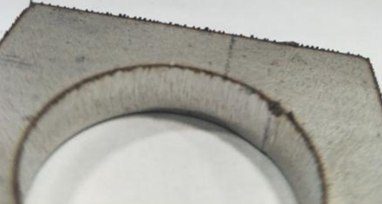
Burr on stainless cut with nitrogen almost always means the melt is not being blown out fast enough: cutting speed too low for the power, nitrogen pressure or purity too low, a worn or off-centre nozzle, or focus sitting too high in the sheet. Start with nozzle condition and gas pressure — they explain most burr cases in a shop.
Read the answer → - Fiber laser stopped cutting through the sheet — what is wrong?
When a machine that used to cut through stops penetrating, the beam is losing energy on its way to the sheet or landing in the wrong place. In order of likelihood: dirty or cracked protective glass, worn nozzle, focus drift, gas pressure loss, and only then the source itself.
Read the answer → - How do I get rid of dross when cutting mild steel with oxygen?
Dross on mild steel is molten oxide that solidified before the gas could remove it. The usual levers, in this order: oxygen pressure (often too high on thick plate), cutting speed, focus position, and nozzle standoff. On plate above 10 mm, most dross problems are a pressure and focus problem, not a power problem.
Read the answer → - Why is the cut edge rough and striated instead of smooth?
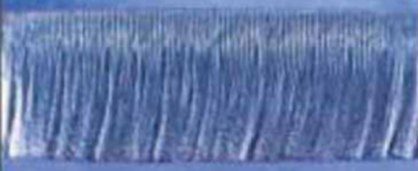
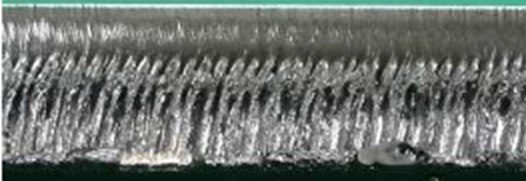
Striations are the fingerprint of an unstable melt front. Coarse, dragging lines mean the melt cannot keep up — usually speed, focus or gas dynamics. Fine even lines are normal and cannot be removed entirely; what you control is their depth and how far down the edge they start.
Read the answer → - Why does my laser cutter throw spatter and clog the nozzle?
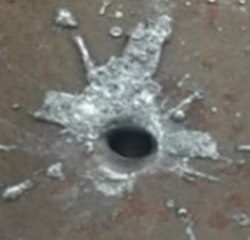
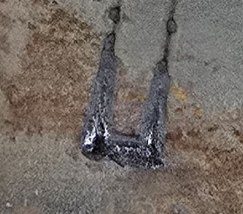
Spatter is melt ejected back up toward the head instead of down through the kerf — usually from piercing thick material too aggressively, standoff set too low, or pressure too high for the nozzle. It clogs the nozzle fast, and a clogged nozzle then makes spatter worse.
Read the answer → - Why is my laser-cut kerf tapered — wider at the top than the bottom?
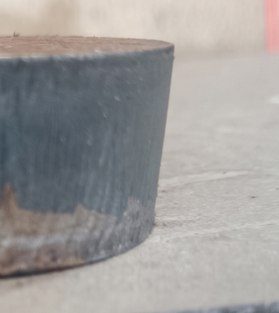
Taper means the beam is not delivering a straight-walled cut through the full thickness: usually focus sitting at or above the surface on thick material, speed slightly too high, or a worn lens spreading the beam. It shows up mostly on plate over 8–10 mm, where the beam has more depth to travel through.
Read the answer →
Parameters and setup
- Where should the focus sit for stainless steel and mild steel?
The rule of thumb: cutting with nitrogen, the focus goes below the surface — roughly a third to two thirds of the thickness down. Cutting mild steel with oxygen, the focus sits at the surface or slightly above it. Thin sheet under 2 mm is close to zero in both cases.
Read the answer → - How long should piercing take, and what parameters does it need?
Piercing time grows with thickness: on a 6 kW fiber, thin sheet pierces in well under a second, 10 mm in roughly one second, and 20 mm plate needs one to three seconds with ramped power. Thick material pierces on oxygen at low pressure with the focus higher than the cutting focus, then switches to the cutting parameter set.
Read the answer → - What cutting speed should I expect per thickness on a fiber laser?
Speed falls sharply with thickness and depends on the gas: a 6 kW fiber cuts 1 mm stainless with nitrogen at 30–40 m/min, 6 mm at around 5 m/min, and 10 mm at 2–3 m/min. Mild steel with oxygen is slower on thin sheet but keeps cutting into 20 mm plate where nitrogen becomes impractical.
Read the answer → - What is kerf in laser cutting, and how wide is it?
Kerf is the width of material the beam actually removes — narrower than a saw cut but not zero. On a 3–6 kW fiber it typically runs 0.1–0.3 mm on thin sheet and grows to 0.4–0.6 mm past 10 mm, driven mostly by nozzle diameter, focus and cutting gas.
Read the answer →
Gas, nozzles, consumables
- How do I choose the nozzle diameter for laser cutting?
Nozzle diameter follows thickness and gas: small single nozzles of 1.0–1.5 mm for oxygen cutting of mild steel, larger double nozzles of 1.4–3.0 mm for nitrogen cutting where a wide, high-pressure jet must clear the melt. Too large a nozzle wastes gas and softens the jet; too small starves the kerf.
Read the answer → - How much nitrogen does laser cutting actually consume?
Consumption is driven by nozzle diameter and pressure, not by the laser power: a 2.0 mm nozzle at 15 bar puts roughly 30–45 m³/h through the kerf, and a 3.0 mm nozzle at 20 bar can exceed 90 m³/h. That is why thick-plate nitrogen cutting is often the largest single line in the cost per part.
Read the answer → - Oxygen or nitrogen — which assist gas should I use?
Oxygen burns as it cuts, so it is faster and cheaper on mild steel and reaches greater thickness, but leaves an oxidised edge. Nitrogen only blows the melt away, giving a clean, weldable, corrosion-resistant edge on stainless and aluminium at higher pressure, lower speed and much higher gas cost.
Read the answer →
Materials and techniques
- What settings does laser cutting aluminium need?
Aluminium cuts with nitrogen at high pressure, similar to stainless, but its high reflectivity and thermal conductivity mean it needs more power margin for the same thickness and is far less forgiving of a dirty lens or slightly off focus — both cause a lost cut, not just a quality drop.
Read the answer → - Can I cut stainless steel with oxygen instead of nitrogen?
Yes, and it is faster and cheaper than nitrogen, but the edge oxidises: it turns dark or straw-coloured and loses corrosion resistance right at the cut. It suits thick plate, structural parts and anything that gets ground or painted afterward — not visible or weld-critical parts.
Read the answer →
Cost, maintenance and troubleshooting
- What does it actually cost to laser cut one part?
Cost per part is assist gas, electricity, consumables (nozzle, lens, filters) and machine time, roughly in that order of size for nitrogen jobs. On thin mild steel with oxygen, gas and consumables are cheap and machine time dominates; on thick stainless with nitrogen, gas alone can be the largest line.
Read the answer → - Does a nitrogen generator pay for itself?
It depends on hours cut per week and cylinder price, not on machine power. A shop running stainless several shifts a day on cylinder nitrogen often recovers a mid-size generator in one to two years; a shop cutting nitrogen only occasionally rarely breaks even.
Read the answer → - What laser cutting machine maintenance should I do, and how often?
A working routine covers four intervals: daily lens and nozzle checks, weekly rail and optics cleaning, monthly gas-line and filter inspection, and periodic chiller and beam-path service tracked by operating hours, not the calendar. Skipping the daily checks is what causes most of the defects covered elsewhere on this site.
Read the answer → - How do I check if my laser beam is misaligned?
Misalignment shows up as quality that differs by direction or position on the table, not as a single obvious fault: cuts fine on one axis but rough on the other, or good near the centre and worse toward the edges. A burn-paper test at two points on the beam path finds it faster than guessing from the cut alone.
Read the answer → - What do laser cutting machine error codes mean?
Most fault codes fall into two families: chiller codes (temperature, flow, pressure — usually E-prefixed) and servo-drive alarm codes (encoder, overheat, communication — usually letter codes on the drive display). Both point to a specific subsystem, not the laser source itself, and most have a simple first check before calling service.
Read the answer →