How long should piercing take, and what parameters does it need?
Updated:
Short answer
Piercing time grows with thickness: on a 6 kW fiber, thin sheet pierces in well under a second, 10 mm in roughly one second, and 20 mm plate needs one to three seconds with ramped power. Thick material pierces on oxygen at low pressure with the focus higher than the cutting focus, then switches to the cutting parameter set.
Why piercing fails
| Symptom | Likely cause | First action |
|---|---|---|
| Cut starts before penetration; the head drags a blob and the contour is ruined from the first millimetre. | Pierce time too short for the thickness | Extend dwell; on plate use a ramped pierce rather than a single long pulse. |
| Nozzle clogs within a few pierces; burr appears immediately after. | Spatter thrown back onto the nozzle | Raise the pierce standoff, lower pressure, and use a pierce with rising power instead of full power from the start. |
| A crater in the finished part edge. | Pierce point placed on the contour | Move the pierce into scrap and lead in — this is a CAM setting, not a machine fault. |
| Long, unstable pierce on thick mild steel with nitrogen. | Wrong gas for piercing | Pierce thick mild steel with oxygen at low pressure, then switch gas for the cut if the part needs a clean edge. |
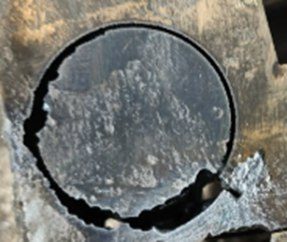
Piercing table by material, thickness and gas — inside the app. Open SBM Laser Help →
Or take it with you:
Piercing time — typical values, 6 kW fiber
| Thickness | Gas | Pierce time | Standoff |
|---|---|---|---|
| 1–3 mm | Same as cutting | 0.1–0.3 s | Cutting standoff |
| 6 mm | Oxygen, low pressure | 0.4–0.7 s | 1.5–2 mm |
| 10 mm | Oxygen, low pressure | 0.8–1.2 s | 2–3 mm |
| 16 mm | Oxygen, ramped power | 1.5–2.5 s | 3–4 mm |
| 20 mm | Oxygen, ramped power | 2–3.5 s | 4–5 mm |
Ramped piercing trades a little cycle time for far fewer scrapped nests and nozzle changes.
Related questions
- Is a flying pierce worth it?
- On thin sheet with many holes, yes — it removes most of the pierce dwell and can cut nest time noticeably. On plate it is not appropriate: penetration needs the dwell.
- Why does the first pierce of a shift behave differently?
- Cold optics and a cold sheet change the thermal balance slightly. Many shops cut a sacrificial pierce or a short warm-up nest before production.