Why does my laser cutter throw spatter and clog the nozzle?
Updated:
Short answer
Spatter is melt ejected back up toward the head instead of down through the kerf — usually from piercing thick material too aggressively, standoff set too low, or pressure too high for the nozzle. It clogs the nozzle fast, and a clogged nozzle then makes spatter worse.
What causes spatter
| Symptom | Likely cause | First action |
|---|---|---|
| Spatter concentrated at pierce points, not along the cut. | Pierce dwell too long or full power applied from the very start. | Use ramped-power piercing on plate over 6 mm instead of a single full-power pulse. |
| Fine spatter dusting the surface near the head. | Standoff too low, gas jet bouncing spatter back up. | Raise standoff slightly at pierce, especially on thick material; confirm the capacitive sensor is calibrated. |
| Nozzle clogs within a few pierces on thick plate. | Same as above, compounding — a clogged orifice further disrupts the gas jet. | Clean or replace the nozzle, then fix the pierce settings so it does not recur. |
| Spatter appears only on a specific material batch. | Rust, mill scale or coating throwing off extra material during piercing. | Adjust pierce parameters for scaled material, or clean the surface first. |
| Spatter increased after a nozzle or lens change. | New nozzle changes standoff geometry; parameters tuned for the old one no longer match. | Re-run a short pierce test after every consumable change on thick plate. |
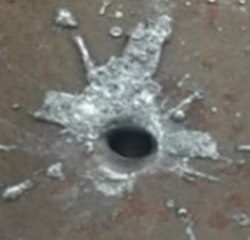
Photo diagnosis flags spatter causes against 47 catalogued defects. Open SBM Laser Help →
Or take it with you:
What to check, in order
- Inspect the nozzle immediately — clogging compounds every other symptom.
- Check pierce dwell and power ramp for the current thickness; thick plate needs staged power, not full power from the first millisecond.
- Verify standoff at pierce versus at cut — some controllers use different values for each.
- Confirm gas pressure is not higher than the nozzle and material call for; excess pressure blows melt sideways and up, not just down.
Related questions
- Is some spatter during piercing normal?
- A small amount around the pierce point is normal on thick plate, especially with oxygen. Spatter that reaches the nozzle or lens, or continues along the cut, is not.
- Can spatter damage the protective glass?
- Yes — that is the main risk. Spattered glass loses power and shifts focus, which then causes burr and penetration problems on top of the spatter itself.
- Does slower piercing always reduce spatter?
- Usually, but not always — too slow on thick plate can overheat the melt pool and cause the opposite problem, an explosive ejection. Ramped power controls both ends better than dwell time alone.