Fiber laser settings for 10 mm mild steel at 6 kW
Updated:
Short answer
A 6 kW fiber laser cuts 10 mm mild steel with oxygen at 0.55–1.2 bar and 1.8–3.3 m/min. For this combination we have 12 regimes: the base one from the source maker’s table and 11 alternatives from other sources.
Mild steel cutting speed and gas pressure at 6 kW
Base regime · Mild steel · 10 mm · 6 kW
RFL-6000(100u), Cutting head focal length: Collimating 100/Focal 200
Gas
O₂
Gas pressure
0.6bar
Speed
2–2.3m/min
Power
92%
Frequency
5000Hz
Duty cycle
92%
Focus
in the app
Cutting height
in the app
Nozzle
in the app
Alternative 1 · Mild steel · 10 mm · 6 kW
MAX MFSC-6000W-100um, Head: none
Gas
O₂
Gas pressure
0.6bar
Speed
2.1m/min
Power
100%
Frequency
5000Hz
Duty cycle
100%
Focus
in the app
Cutting height
in the app
Nozzle
in the app
Alternative 2 · Mild steel · 10 mm · 6 kW
Raycus, Head: none
Gas
O₂
Gas pressure
0.65bar
Speed
2.2m/min
Power
86%
Frequency
5000Hz
Duty cycle
90%
Focus
in the app
Cutting height
in the app
Nozzle
in the app
Alternative 3 · Mild steel · 10 mm · 6 kW
Raycus, Head: raytools BM06K
Gas
O₂
Gas pressure
0.78bar
Speed
2.1m/min
Power
88%
Frequency
5000Hz
Duty cycle
100%
Focus
in the app
Cutting height
in the app
Nozzle
in the app
Alternative 4 · Mild steel · 10 mm · 6 kW
Raycus, Head: none
Gas
O₂
Gas pressure
0.75bar
Speed
2.1m/min
Power
95%
Frequency
5000Hz
Duty cycle
100%
Focus
in the app
Cutting height
in the app
Nozzle
in the app
Alternative 5 · Mild steel · 10 mm · 6 kW
Raycus, Head: none
Gas
O₂
Gas pressure
1.2bar
Speed
2.3m/min
Power
100%
Frequency
5000Hz
Duty cycle
100%
Focus
in the app
Cutting height
in the app
Nozzle
in the app
Alternative 6 · Mild steel · 10 mm · 6 kW
MAX, Head: WSX
Gas
O₂
Gas pressure
0.8bar
Speed
1.8m/min
Power
100%
Frequency
5000Hz
Duty cycle
100%
Focus
in the app
Cutting height
in the app
Nozzle
in the app
Alternative 7 · Mild steel · 10 mm · 6 kW
Raycus, Head: BOCI BLT
Gas
O₂
Gas pressure
0.68bar
Speed
2.3m/min
Power
99%
Frequency
5000Hz
Duty cycle
1000%
Focus
in the app
Cutting height
in the app
Nozzle
in the app
Alternative 8 · Mild steel · 10 mm · 6 kW
Raycus, Head: BOCI BLT 420s
Gas
O₂
Gas pressure
0.55bar
Speed
2.4m/min
Power
100%
Frequency
5000Hz
Duty cycle
100%
Focus
in the app
Cutting height
in the app
Nozzle
in the app
Alternative 9 · Mild steel · 10 mm · 6 kW
IPG, Head: Precitec
Gas
O₂
Gas pressure
0.6bar
Speed
3.3m/min
Power
100%
Frequency
5000Hz
Duty cycle
100%
Focus
in the app
Cutting height
in the app
Nozzle
in the app
Alternative 10 · Mild steel · 10 mm · 6 kW
gw, Head: NC63A
Gas
O₂
Gas pressure
0.8bar
Speed
2.5m/min
Power
100%
Frequency
5000Hz
Duty cycle
100%
Focus
in the app
Cutting height
in the app
Nozzle
in the app
Alternative 11 · Mild steel · 10 mm · 6 kW
GW, Head: none
Gas
O₂
Gas pressure
0.8bar
Speed
2.3m/min
Power
100%
Frequency
5000Hz
Duty cycle
100%
Focus
in the app
Cutting height
in the app
Nozzle
in the app
Which regime to start with
- Base regime. The starting point for most 6 kW machines, from the source maker’s own table.
- Alternative 1. Source: MAX MFSC-6000W-100um, Head: none. Pressure and speed match the base regime; use it if your machine has this source or head.
- Alternative 2. Oxygen pressure 0.1 bar higher. Source: Raycus, Head: none. Try it when the base regime leaves hard dross or the part does not drop out.
- Alternative 3. Oxygen pressure 0.2 bar higher. Source: Raycus, Head: raytools BM06K. Try it when the base regime leaves hard dross or the part does not drop out.
- Alternative 4. Oxygen pressure 0.2 bar higher. Source: Raycus, Head: none. Try it when the base regime leaves hard dross or the part does not drop out.
- Alternative 5. Faster: 2.3 m/min against 2–2.3 m/min. Oxygen pressure 0.6 bar higher. Source: Raycus, Head: none. Try it when the cut is clean and you want more speed; if the edge gets worse, go back to the base regime.
- Alternative 6. Slower: 1.8 m/min against 2–2.3 m/min. Oxygen pressure 0.2 bar higher. Source: MAX, Head: WSX. Try it on a rusty or scaled sheet, or when the base regime does not cut through cleanly.
- Alternative 7. Faster: 2.3 m/min against 2–2.3 m/min. Oxygen pressure 0.1 bar higher. Source: Raycus, Head: BOCI BLT. Try it when the cut is clean and you want more speed; if the edge gets worse, go back to the base regime.
- Alternative 8. Faster: 2.4 m/min against 2–2.3 m/min. Source: Raycus, Head: BOCI BLT 420s. Try it when the cut is clean and you want more speed; if the edge gets worse, go back to the base regime.
- Alternative 9. Faster: 3.3 m/min against 2–2.3 m/min. Source: IPG, Head: Precitec. Try it when the cut is clean and you want more speed; if the edge gets worse, go back to the base regime.
- Alternative 10. Faster: 2.5 m/min against 2–2.3 m/min. Oxygen pressure 0.2 bar higher. Source: gw, Head: NC63A. Try it when the cut is clean and you want more speed; if the edge gets worse, go back to the base regime.
- Alternative 11. Faster: 2.3 m/min against 2–2.3 m/min. Oxygen pressure 0.2 bar higher. Source: GW, Head: none. Try it when the cut is clean and you want more speed; if the edge gets worse, go back to the base regime.
Cutting time and gas consumption per metre
At these speeds one metre of cut takes about 18–33 seconds. Oxygen flow through the nozzle is about 1.2–2.5 m³ per hour, or 8–17 litres per metre of cut, not counting piercing.
Mild steel cutting speed chart: neighbouring thickness and power
| Thickness · power | Gas | Speed, m/min |
|---|---|---|
| 6 mm · 6 kW | N₂ / air | 5–6 |
| 6 mm · 6 kW | O₂ | 2.7–3.2 |
| 8 mm · 6 kW | O₂ | 2.2–2.5 |
| 10 mm · 4 kW | O₂ | 1.8–2 |
| 10 mm · 6 kW | O₂ | 2–2.3 |
| 10 mm · 8 kW | O₂ | 2.3 |
| 10 mm · 10 kW | N₂ / air | 3.5–4.5 |
| 10 mm · 10 kW | O₂ | 2–2.3 |
| 12 mm · 6 kW | O₂ | 0.9–1 |
| 12 mm · 6 kW | O₂ | 1.9–2.1 |
| 14 mm · 6 kW | O₂ | 0.8–0.9 |
| 14 mm · 6 kW | O₂ | 1.4–1.7 |
Going from 6 kW to 8 kW gives about 7% more speed on 10 mm with oxygen. Nitrogen or air cuts about 1.9 times as fast as oxygen here, but needs 10 kW.
Common mild steel cutting defects with oxygen
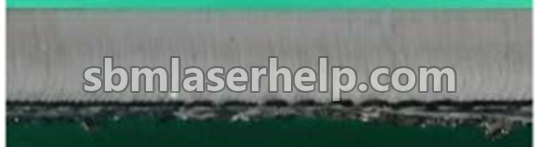
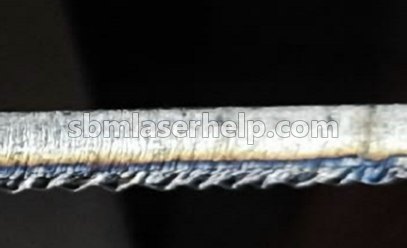
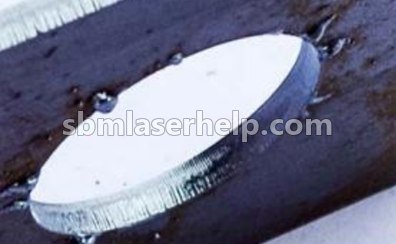
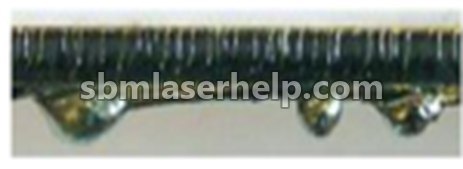
Not sure which one you have? Send a photo of the edge to the app and it names the defect and the fix.
Related questions
- Can a 6 kW fiber laser cut 10 mm mild steel with nitrogen or air?
- Our tables give nitrogen or air for 10 mm mild steel starting from 10 kW, at 3.5–4.5 m/min. At 6 kW the working choice is oxygen: the burning iron adds the heat the beam alone does not have.
- What is the thickest mild steel a 6 kW fiber laser cuts?
- Our tables go up to 25 mm mild steel at 6 kW, at 0.5 m/min with oxygen. The next thickness, 26 mm, starts from 3 kW.
- Why is the speed a range?
- Sheet surface, mild steel grade, oxygen purity and the state of the protective window all shift the result. Start at the lower value, make a test cut and raise the speed in 5% steps while the bottom edge stays clean.
- Where are focus, cutting height and nozzle?
- They depend on the cutting head and lens, so a single number is often wrong for your machine. The app shows the full regime and fits it to the machine you add to your profile.